
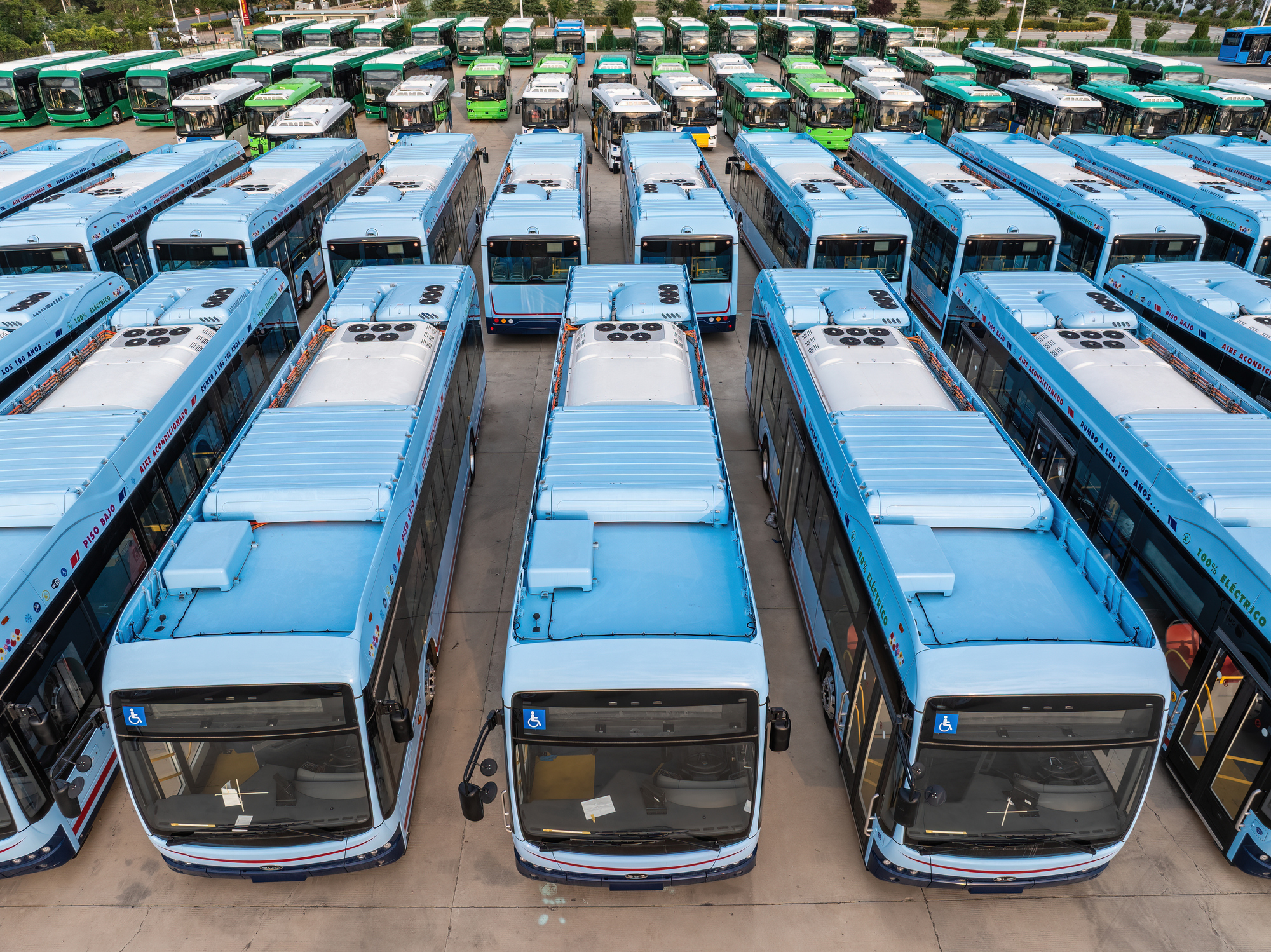
Bus depots are no longer just places to park and refuel buses. The shift to electric fleets, driver shortages, and new mobility models are transforming depots into strategic assets that enable transport operators to improve their business models and scale their fleets.
In this insight, Bax Public Mobility Consultants Giel Mertens and Merlijn Zurek explore how modern bus depots can put more buses on public roads and improve access to mobility for all.
The changing role of bus depots
For decades, a bus depot was simply a place to park, clean, and fuel buses before sending them out the next day. That era is ending. Today’s public and private bus operators face multiple pressures that make the old depot model untenable:
- Electrification and dynamic charging: European regulations are accelerating the shift to electric buses. Across Europe, battery-electric buses now account for a fast-growing share of new city-bus registrations, driven by climate commitments and clean-air goals. For example, as of 2025, the Netherlands requires all new buses in public-transport concessions to be 100% zero-emission, with full fleets converted by 2030. However, operators often have to wait months or even years for the grid connections needed to support electrification. Expanding a depot’s power supply can cost several million euros and require significant infrastructure upgrades. Compared with refueling, charging is also a slower, more frequent process that must be carefully scheduled. Buses may need to charge multiple times per day or overnight, often during off-peak hours to avoid straining the grid. Smart charging schedules are therefore essential to prevent large power spikes when many buses charge simultaneously.
- Diversified fleets and services: Mobility services are becoming more varied. Besides standard city buses, operators now deploy smaller shuttles for on-demand services in low-demand areas, as well as larger buses for regional routes. Fleets also include different propulsion types, such as diesel for long-distance travel and battery-electric or hydrogen buses for urban routes. As a result, buses are no longer interchangeable. Different vehicles have specific range, charging capacity, and route suitability, and schedules are increasingly dynamic and demand driven. Nowadays, depots must solve a daily puzzle of which bus goes where and when, often with limited space for maneuvering.
- Fleet centralisation pressures: In the past, private bus and coach companies often parked vehicles in small lots or on city streets near where they started their service. Now, urban policies aimed at improving livability are tightening. Higher parking fees, stricter permits, and environmental zones make dispersed parking less viable. At the same time, the lack of public charging infrastructure for heavy vehicles pushes operators toward central depots where high-power chargers can be installed. The result is more vehicles concentrated in each depot, with greater pressure on limited charging infrastructure.
Public and private operators feel the implications of these trends in different ways. Public transit agencies often have mandatory zero-emission targets written into their contracts and must meet government requirements. Private operators may not face the same legal obligations to electrify but increasingly experience market pressure from corporate sustainability goals and urban clean-air regulations. Many will not invest in electric buses until they are confident that the charging infrastructure and grid capacity can truly support them. Despite these differences, both sectors face the same infrastructure bottleneck and the need to adapt depots to new operational realities.
The net effect of these trends is that buses are moved around depots far more than before. Instead of parking once a day, they now queue up for charging slots and shuffle between arrival bays, charging stations, washing stations, and maintenance garages. These extra movements cost time and labour, creating a new challenge: more work, but fewer drivers.
More work, fewer drivers
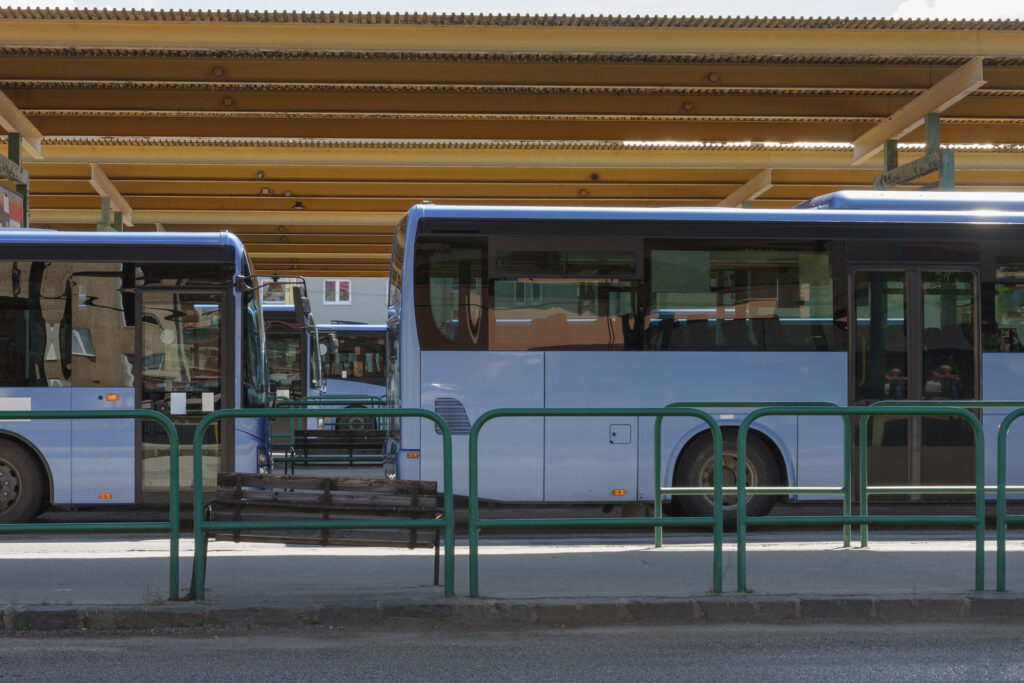
Increased depot activity already brings logistical challenges, exacerbated further by ongoing driver shortages. Across Europe, bus operators are struggling to recruit and retain drivers. In 2023, more than 105,000 bus and coach driver positions were unfilled (about 10% of the total workforce), and this shortage could exceed 275,000 by 2028 if no action is taken. The consequences are already visible: public transport agencies have had to reduce services because of insufficient staff numbers.
According to Arno van der Steen, Consultant at Dutch CCAM specialist V-tron, ongoing initiatives such as the FLEX project provide the opportunity to demonstrate that bus automation does not lead to job losses, but rather to better, broader deployment of bus drivers and a reduction in transport poverty in rural areas.
Every hour spent by a driver maneuvering and parking buses within a depot is an hour not spent transporting passengers. Despite this, drivers still spend time on low-skill tasks such as moving buses between parking spaces, plugging in chargers, or driving through the wash. These tasks can account for roughly 6% of a driver’s shift, with already scarce capacity being consumed by work that does not actually move passengers and therefore does not generate value. For private operators, this dead time is pure cost with no income. For public agencies, it increases operating budgets and scheduling pressure.
The challenge is not only about headcount, it is also about making the job more attractive and sustainable. IRU’s findings underline that many drivers value respect, dignity, and better working environments as much as pay. The depot is where each shift begins and ends, making it a key place to improve the driver experience. If this time is dominated by tight maneuvering, waiting for charging slots, and stressful operational tasks, the job becomes unnecessarily demanding.
In short, the bus industry is squeezed by the energy transition and labour shortages, and depots sit at the intersection of these challenges. Transforming depots into smarter operational hubs can help address both.
Automation
We see automation as a potential solution, by enabling buses to move inside the depot without a driver. Following the completion of a route, a driver could leave the bus at a designated handover point, after which the vehicle would drive itself to a charging station, wash bay, or parking space. In the morning, it could position itself at the depot exit, fully prepared for the next shift.
The benefits of automating internal movement are strong:
- 24/7 operations without night shift labour: With automated systems, buses can be charged at optimal times without requiring staff on-site. Remote supervision replaces onboard drivers, enabling continuous operations.
- Freeing drivers for core services: When buses move themselves, drivers are no longer required to perform shunting tasks and can focus on transporting passengers or benefit from additional rest.
- Tighter parking and less damage: Machine-precision driving allows buses to park closer together and execute difficult maneuvers safely. A self-parking system can improve space efficiency and reduce slow-speed collisions.
- Optimised workflow for all depot services: Beyond just charging, automation means buses could drive themselves through washing, maintenance, and charging processes with minimal human intervention, ensuring every vehicle is ready for service each morning. This also reduces the chance of human error in the process, such as someone forgetting to top up fluids or check a tire.
In this model, a driver’s workday becomes simpler: complete the route, drop the bus at the handover point, and finish the shift. The system handles the rest.
However, automation is not only about the vehicles themselves. A depot can only truly run with fewer people if underlying processes are also digitised and automated. This means connecting systems for charging management, fleet management, maintenance planning, and depot operations so that dispatching, charging, and servicing are coordinated in a single operational view.
Process automation can therefore be a logical first step before vehicle automation itself. Once workflows and decision-making are orchestrated, automating the physical movements becomes the natural next stage. Eventually, this approach can extend to back office processes such as work orders, reporting, and inventory management, creating a scalable ‘smart depot.’
Three pathways to an automated bus depot
How do you enable a bus to move with no driver? Broadly, the industry is exploring three main approaches to automation in depots.
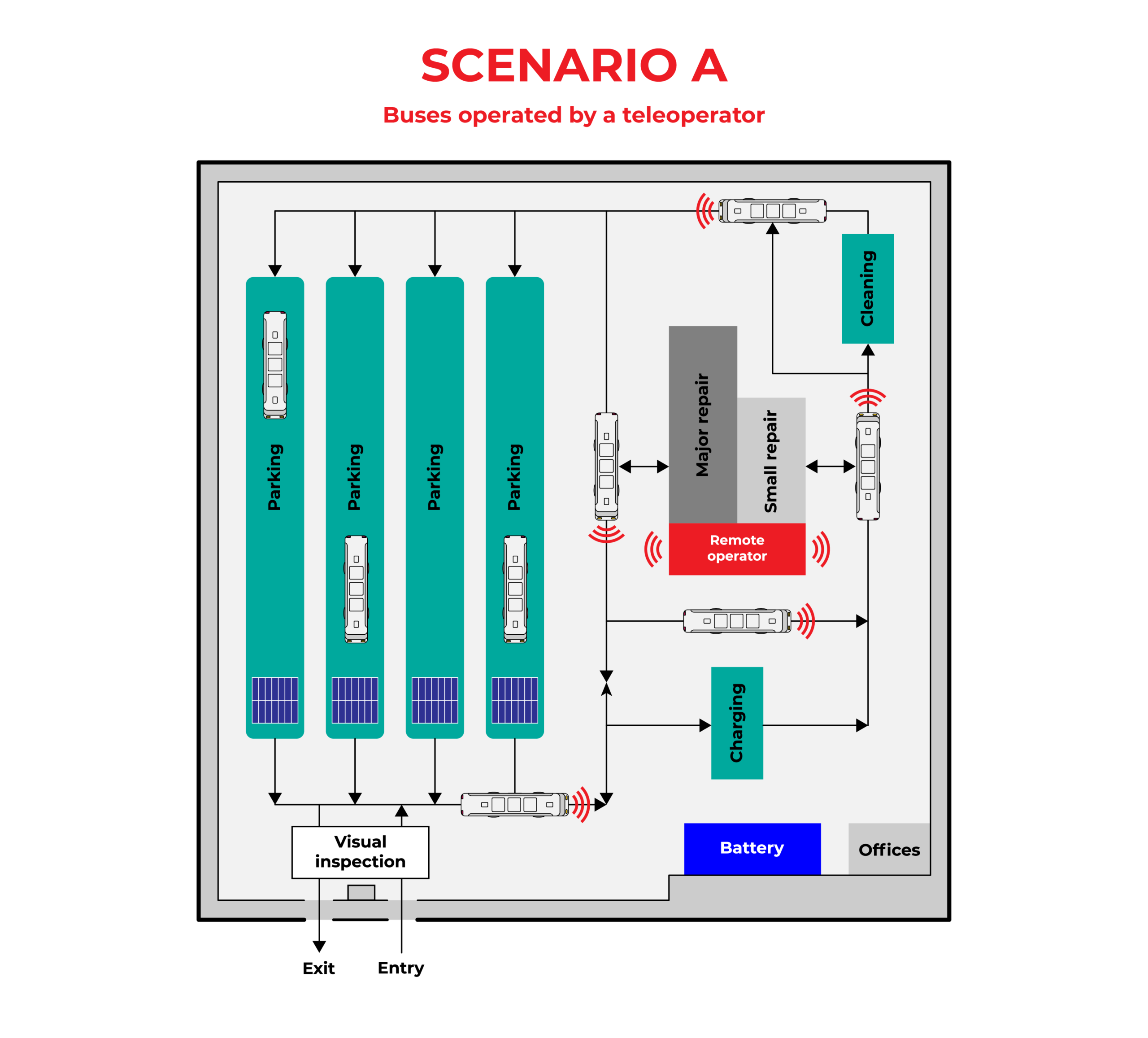
1. Teleoperation
In a teleoperated system, buses are driven by a human, but not from behind the wheel. Instead, a remote operator sits in a control center and controls the bus via software. Teleoperation can be done on demand, whenever a bus needs to relocate. It reduces on-site staff, as one person could manage movements for many depots from a central location, but it does not eliminate human labour entirely. This can be seen as an interim step towards full automation.
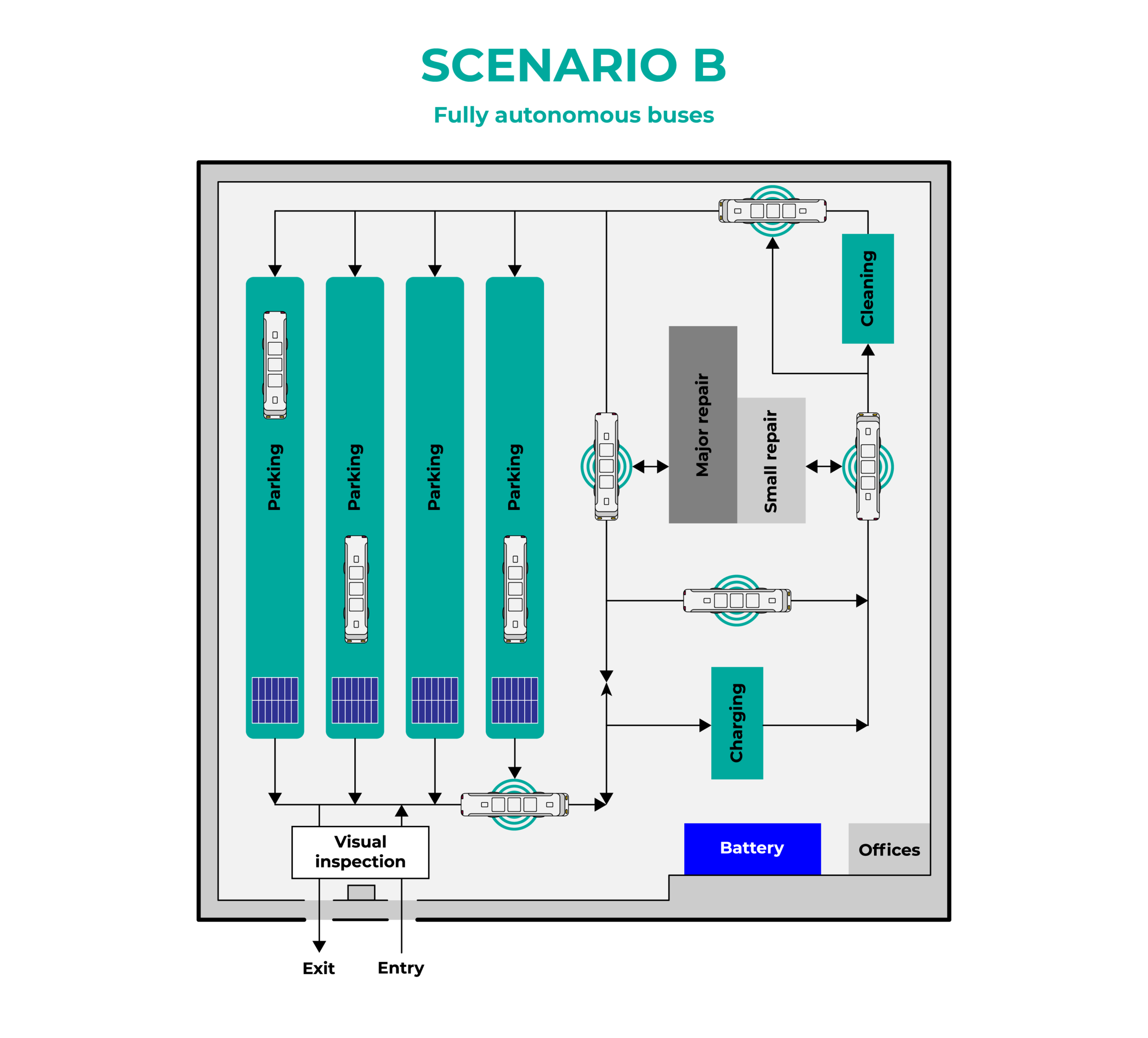
2. Onboard autonomous driving
This approach equips the bus itself with autonomous driving capabilities. The bus can then navigate the depot on its own, making decisions in real time without human control. This completely removes the need for staff for vehicle movement.
3. Smart infrastructure (external guidance)
Rather than making each vehicle autonomous, this approach makes the depot smart. It involves installing sensors (cameras, radar) around the facility and guidance systems (like magnetic tracks, or even rail-like guidance) that take over control of a “dumb” vehicle.
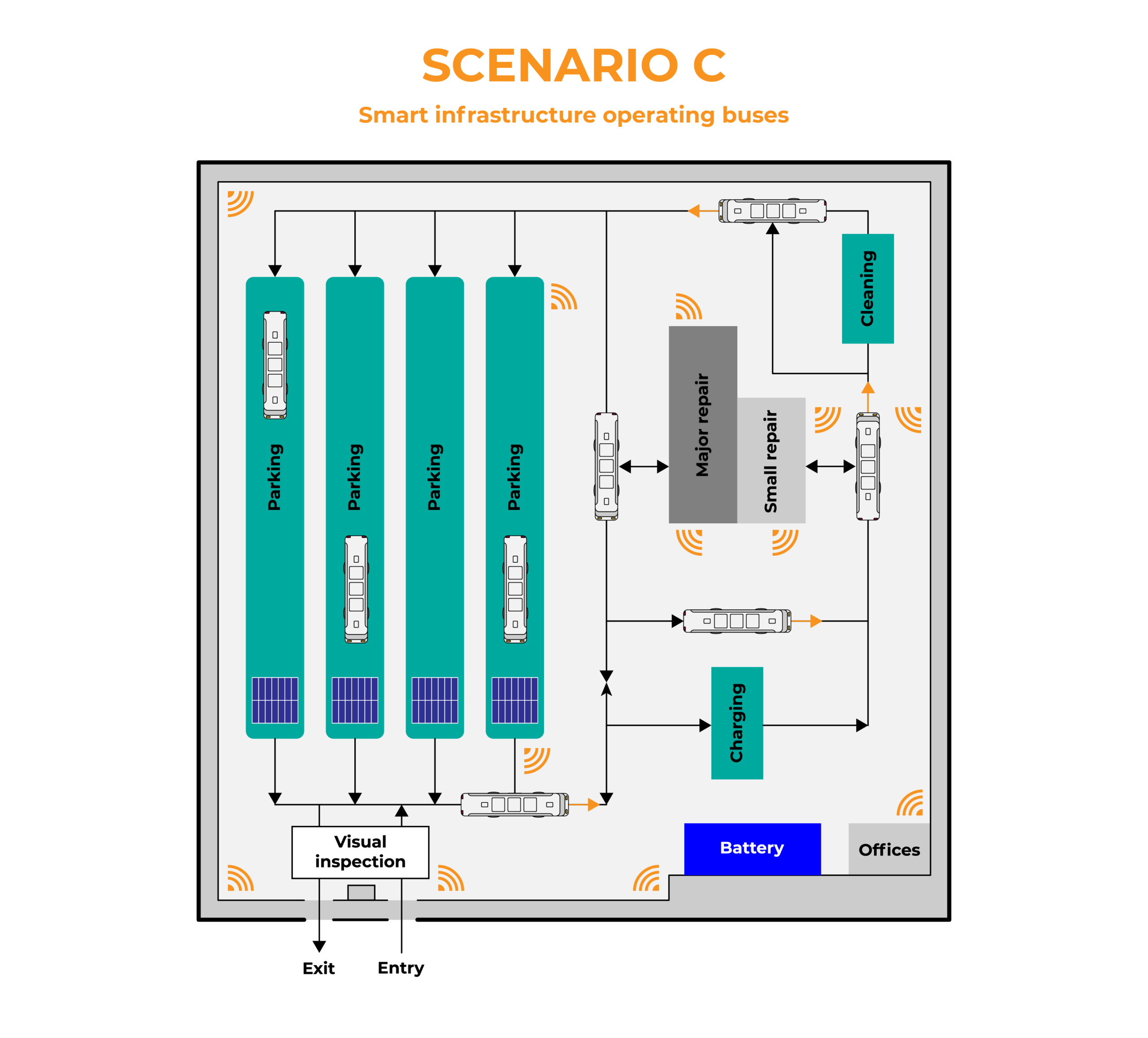
It is worth noting that these approaches are not mutually exclusive. Operators may start with teleoperation, then gradually introduce more autonomous features in vehicles or infrastructure as confidence grows. Importantly, much of the required technology already exists.
For years, we have been trying to get autonomous vehicles on the road in the most complex situations, to transport passengers safely in mixed traffic. Presently, we are not advanced enough to deploy these on public roads. However, we are forgetting to focus on other, more feasible, business cases, like bus depots. Here, fast driving is not required, the environment is controlled, routes are predictable, and the vehicles do not carry humans. In other words, the current AV technology is already ahead of what this use case demands, so it is time to start implementing it beyond pilots and feasibility studies.
“Not everything that is technically possible is always necessary, but if we leave these possibilities untested due to legal restrictions, we sometimes miss out on huge opportunities.”
– Arno van der Steen, Consultant at V-tron
Real-world progress
This vision may sound ambitious, but steps are already being taken across Europe.
In Switzerland, the SAAM/AutoDepot initiative has completed a positive feasibility study covering the economic, technical, and legal dimensions of an “automated viable bus depot,” and has moved toward prototyping.
In Sweden, a dedicated study explored the legal and organisational requirements of operating an automated bus depot and concluded that the concept is implementable from a regulatory and operational perspective. On the technology side, a Volvo pilot has demonstrated fully autonomous electric buses performing key depot movements, such as driving between parking, servicing, cleaning, and charging positions.
In Madrid, the SHOW project is piloting teleoperation, enabling buses to be moved and positioned remotely in a controlled environment.
Outside Europe, the idea of using automation in depots is also gaining traction. In the United States, Austin’s CapMetro has demonstrated an automated 12-meter-long electric bus operating inside an active bus yard. In China, pilots in Jinan show autonomous buses parkign themselves and charging via robotic arms.
At Bax, we are also taking steps towards the realisation of the bus depot of the future. We are leading a Dutch-German initiative to showcase teleoperation and autonomous vehicles in public transport. More specifically, in Groningen (The Netherlands) and in Vechta (Germany), we are implementing these technologies.
Additionally, our automated mobility consultancy Pendel is actively testing automated and demand-responsive public transport services. In 2022, Pendel launched the first autonomous-vehic pilot on Spanish public roads in Barcelona.
Get in touch
If you are interested in learning more about bus depots of the future, or you are involved in related mobility technologies, get in touch with us.


