
When we launched our four-year collaboration with the DUT Partnership in July 2024, our ambition was to support one of Europe’s key initiatives for sustainable urban transitions from strategy through to delivery. A year on, we described how that work was moving from vision to impact—shaping DUT’s updated Strategic Roadmap and guiding projects towards concrete outputs.
The next chapter of this collaboration is about connection: linking the research and innovation funded by DUT to the European policy cycles where it can have the most influence, and to the practitioners who can put it to use. Over recent months, Bax has been active on three fronts—bringing project insights into the policy conversation in Brussels, tracking the EU policy landscape, and capitalising on project results through DUT’s Knowledge Hub.
Bringing policy to practice at the DUT Policy Conference in Brussels
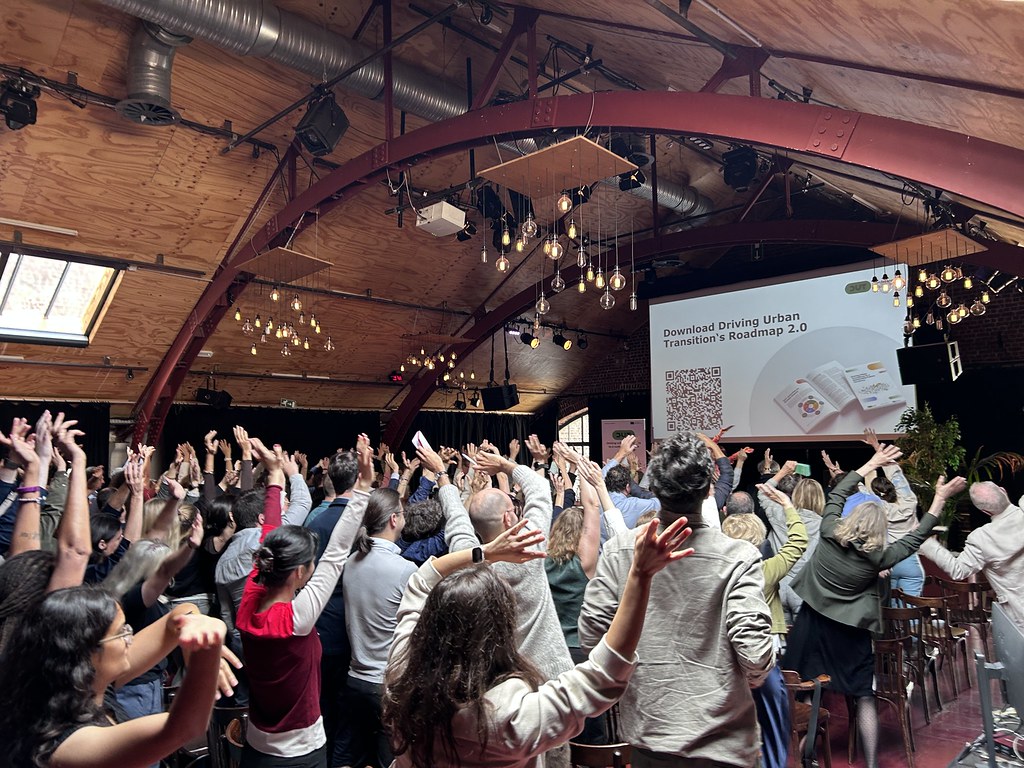
On 10 June, Bax played an active role during the DUT Policy Conference, held during the New European Bauhaus Festival in Brussels. The conference brought together policymakers, researchers and urban practitioners to explore how the results emerging from DUT projects can inform decision-making at local, national, and European levels.
Bax Consultants Juliette Ténart, Zoë de Jonge, and Dominic Stephen each led breakout sessions on the theme of policy to practice. Drawing on concrete examples from DUT-funded projects, we facilitated conversations on how project results relate to live policy debates in the fields of energy, mobility and circularity. The aim was to make the connection tangible: to show how experimentation on the ground speaks directly to the strategic questions facing European cities, and where project evidence can strengthen the policies that shape urban transitions.
Keeping DUT in step with Europe's policy agenda
Behind this work sits a more continuous task: ensuring DUT’s research and innovation remains connected to the policy cycles it can inform. Through our Policy Observatory, Bax monitors EU policies and strategies on mobility, energy, greening, and circularity—including those recently updated, under development, or under active discussion—and links them to DUT’s three Transition Pathways.
By tracking consultations, feedback processes and new strategic directions from the EU, we help to ensure that opportunities to contribute are identified and can be acted upon, and that DUT’s thematic pillars can be steered in step with where Europe is heading.
In practice, this involves two things: mapping the policy debates relevant to DUT as a whole and to each Transition Pathway, including the key moments for feedback and input, and engaging with DUT projects so they can provide that input on the basis of their results. This is how we keep the bridge between research and policy open in both directions.
Turning project results into shared knowledge
The Knowledge Hub is DUT’s instrument for developing a knowledge community, capitalising on project results, and transferring those results to practitioners. Co-led by Bax, it is where individual project findings are brought together and synthesised around the issues that matter most to cities today.
In recent months, team members from across Bax have worked alongside groups of projects to develop publications that connect their individual results to relevant topics in each field. This collaborative work has produced four new publications, each co-authored by Bax colleagues alongside the project teams:
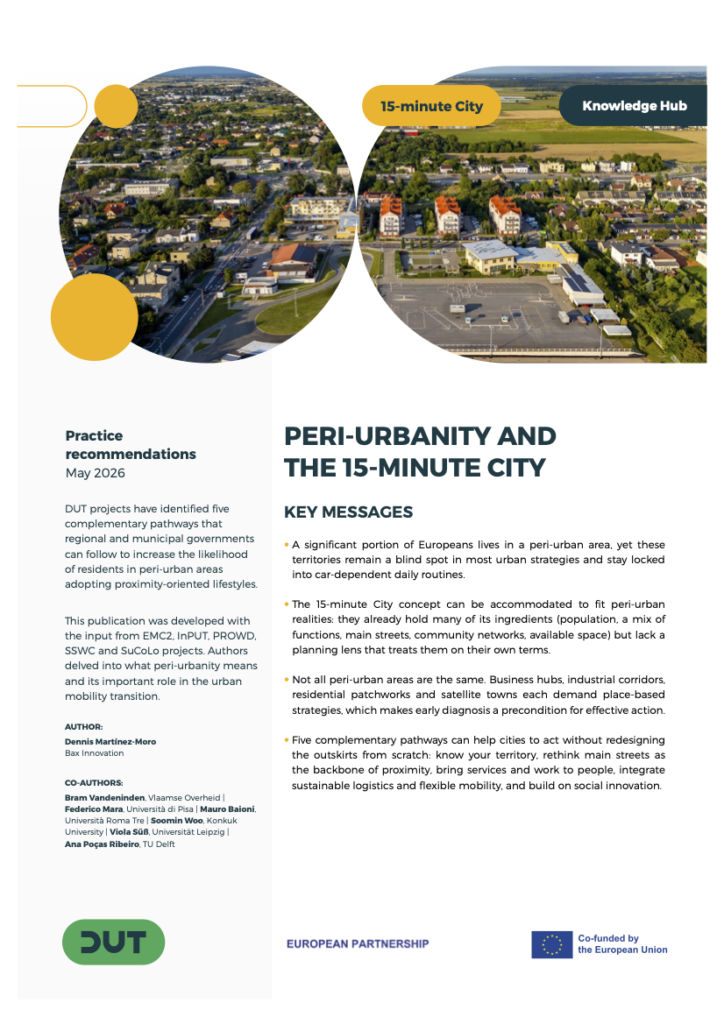
How to encourage residents in peri-urban areas to adopt proximity-oriented lifestyles?
Authored by Dennis Martinez, Bax Innovation.
Drawing on five projects (EMC2, InPUT, PROWD, SSWC and SuCoLo), this publication makes the case that peri-urban areas—home to a large share of Europeans, yet often overlooked—are better served by a “polycentric 15-minute system”: a network of walkable nodes connected by cycling and public transport, where residents can meet most daily needs locally without depending on the car. It sets out five complementary pathways that regional and municipal governments can follow, from understanding the territory before intervening to building on local social-innovation networks.
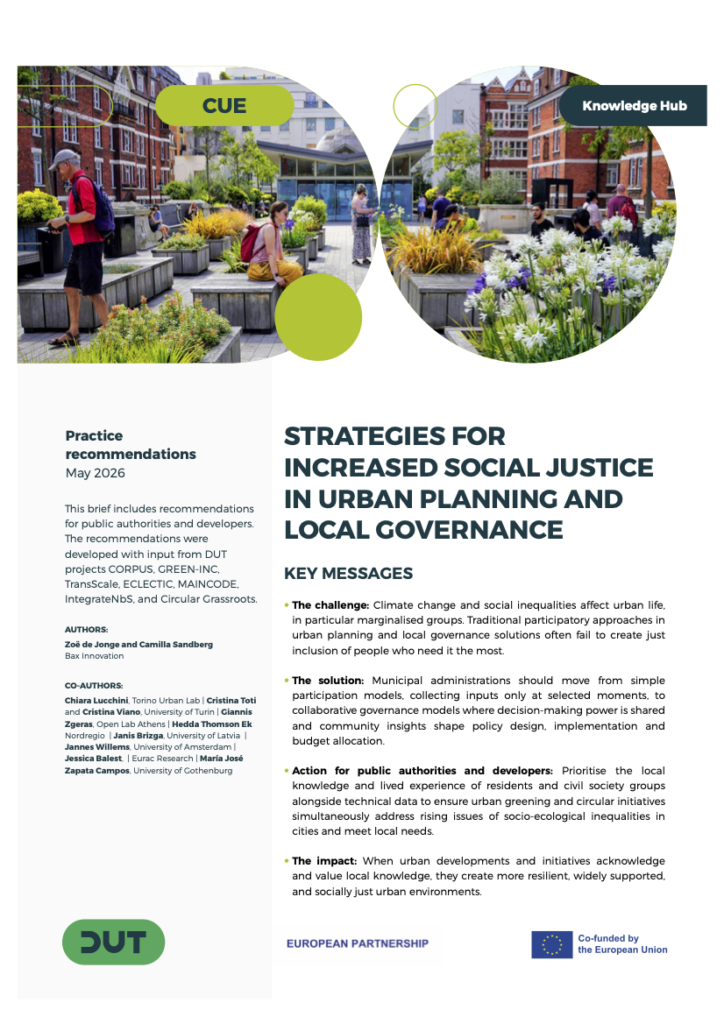
Strategies for increased social justice in urban planning and local governance
Authored by Camilla Sandberg and Zoë de Jonge, Bax Innovation
Based on seven projects (CORPUS, GREEN-INC, TransScale, ECLECTIC, MAINCODE, IntegrateNbS and Circular Grassroots), this brief offers ten practice recommendations for public authorities and developers. It argues that genuinely just participation requires three shifts: making participation accessible and re-balancing power, building diverse networks and embracing constructive conflict, and turning input into action by aligning engagement with real policy and budget timelines.
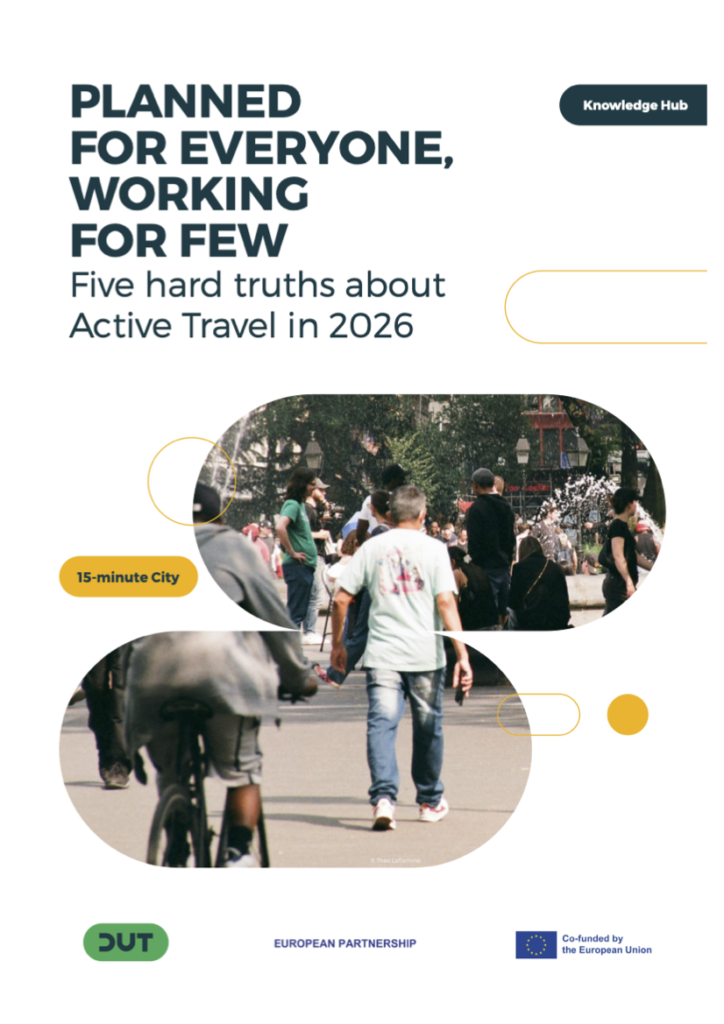
Planned for everyone, working for few: five hard truths about active travel in 2026
Authored by Juliette Ténart, Bax Innovation
Bringing together findings from Silver Ways, 15minESTATES, Dreams, COLINE and ENACT 15mC—with studies in cities including Budapest, Delft, Munich, Uppsala, Sofia, Valencia and Vienna—this publication makes a pointed argument: if we are serious about the 15-minute city, we must stop treating active travel as a simple good that simply requires more encouragement, and start planning it as the complex, multi-modal system it really is. The five “hard truths” range from the limits of the shortest-route assumption to the reality that co-creation only delivers when it hands over genuine power.
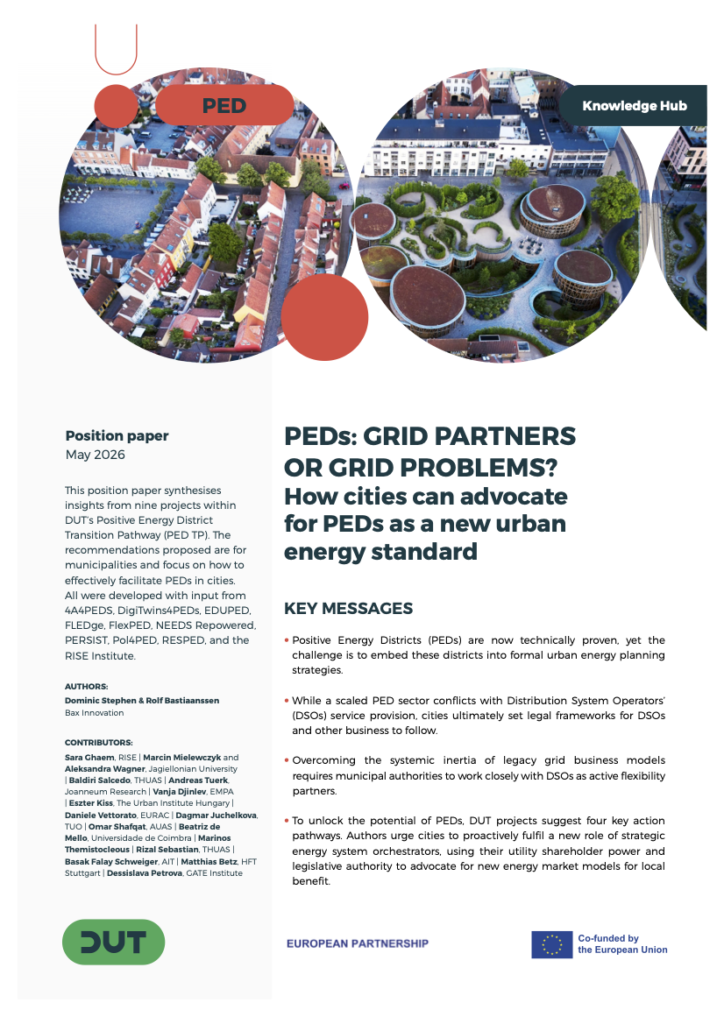
Authored by Dominic Stephen and Rolf Bastiaanssen, Bax Innovation
This position paper synthesises insights from 25 experts, 9 projects and 15 European countries within the Positive Energy Districts Transition Pathway. It positions cities as the optimal actors to facilitate Positive Energy Districts, and proposes four priorities for municipalities: advocating for market-oriented PED support, pushing for supportive policy and local energy markets, demonstrating compelling impact to escape the “pilot trap”, and embedding PEDs within master planning and building codes rather than treating them as green add-ons.
What's next: from knowledge to the Innovation Portfolio
Our collaboration now moves towards DUT’s Innovation Portfolio—the instrument DUT uses to promote the most promising solutions emerging from its projects, ensuring they are widely visible and able to achieve greater impact. Building on the synthesis work of the Knowledge Hub, Bax will continue to lead workshops that link DUT projects to EU policy, helping to identify the solutions with the greatest potential and connect them to the European agenda.
From contributing to the policy conversation in Brussels, to tracking Europe’s evolving policy landscape, to capitalising on project results through the Knowledge Hub, our continued involvement keeps Bax at the forefront of challenge-driven urban innovation. We are proud to help DUT turn the work happening across its projects into tangible influence on the policies and practices that will shape Europe’s urban future.


