
Client: Cornellà de Llobregat City Council
Date: October 2024-June 2025
Location: Cornellà de Llobregat, Catalonia, Spain
The Healthy Cities team carried out a health impact evaluation of Cornellà Natura, an integrated urban transformation programme led by Cornellà de Llobregat City Council that has been expanding green infrastructure and improving mobility across the municipality since 2016.
The evaluation enabled the City Council to quantify how this combined greening-and-mobility approach affects not only the quality of public space, but also population health outcomes. Building on these findings, the City Council can continue implementation on a stronger evidence base, sharpening focus on the measures that deliver the greatest benefits for residents.
Challenge
Demonstrating real-world impact of urban transformation programmes – at both city and neighbourhood level – is essential to support continued improvements and better decision-making. After seven years of implementation, Cornellà aimed to assess how Cornellà Natura has influenced urban environmental quality and population health and wellbeing, while clarifying which indicators and data are needed to support continuous monitoring and adaptive, evidence-based policy.
Approach
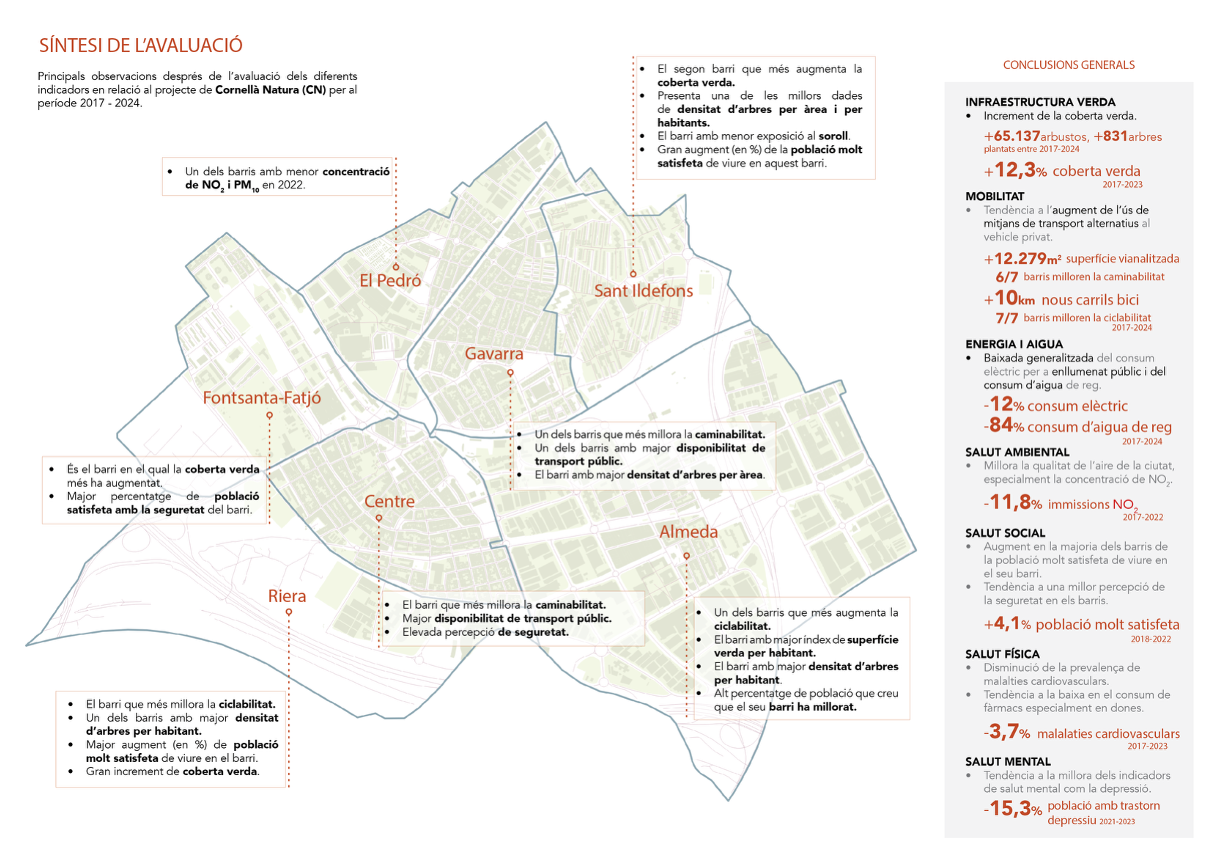
Healthy Cities applied its established evaluation methodology to build a structured, data-driven diagnosis of impact. The study analysed 20 urban health determinants, using the Healthy Cities Generator alongside thorough data collection and spatial analysis to link changes in the urban environment to measurable health outcomes. Results were synthesised at both municipality and neighbourhood level, enabling the City Council to identify where impacts were strongest and where further action could be prioritised.
Impact
The evaluation produced robust, decision-grade evidence on the impacts of Cornellà Natura across the urban environment, public health, and economic value creation. The study identified, among others:
To support continued delivery and accountability, Healthy Cities also strengthened the City Council’s monitoring capacity by developing indicator tables with KPIs and defined data sources, and produced citizen-facing communication materials to report progress and maintain public engagement.
We were very clear that investing in green is ultimately investing in people. Cities need to breathe, and green spaces can be a driver of quality of life. This not only delivers environmental benefits, but also urban and economic ones.
– Emilia Briones, First Deputy Mayor of Cornellà de Llobregat